The Ups and Downs of the Node.js Event Loop
How Node.js handles thousands of concurrent connections on a single thread, the phases callbacks actually run in, and the mistakes that stall the whole process.
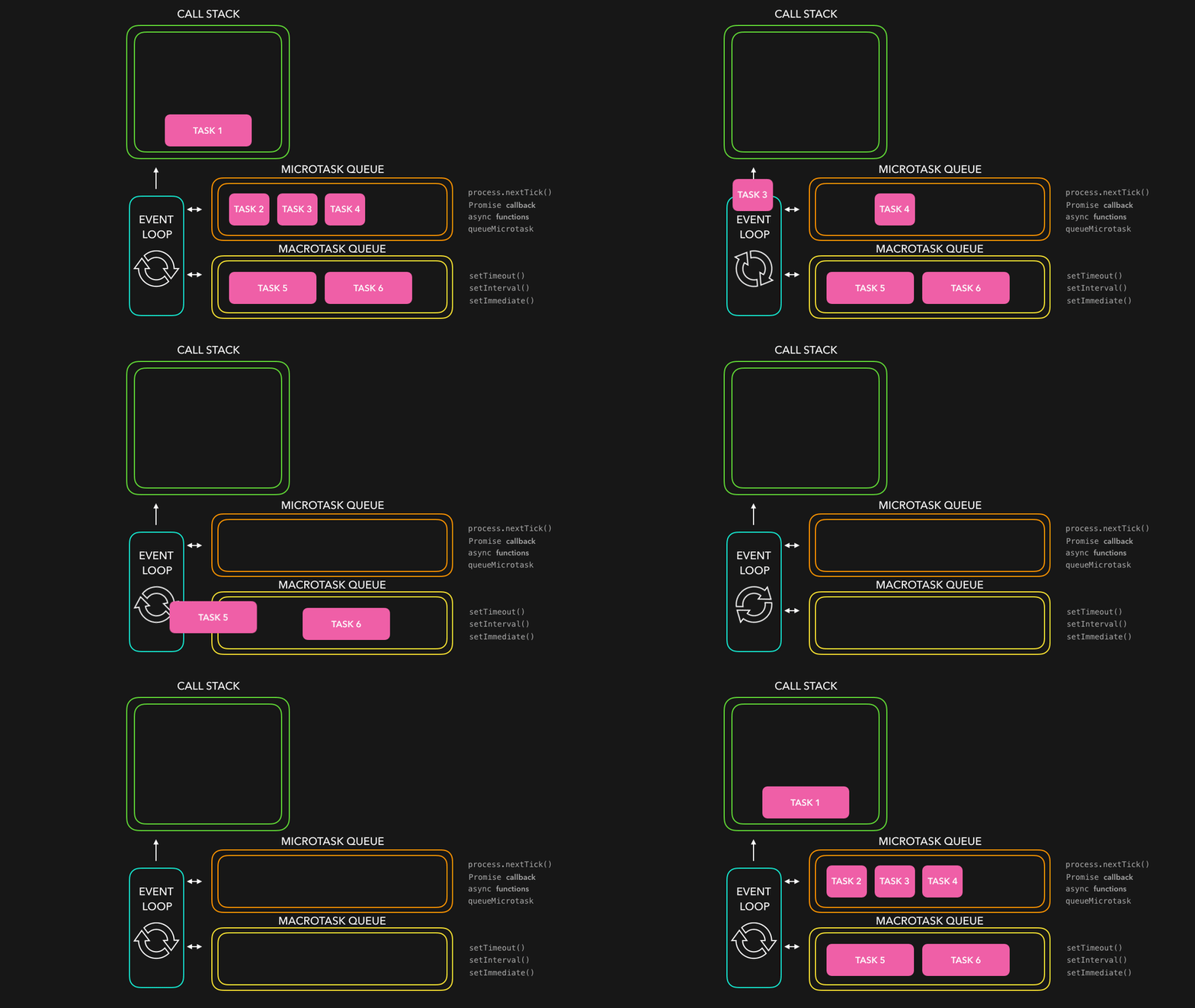
Node.js is known for non-blocking I/O and high concurrency, but the mechanism behind it, the event loop, is widely misunderstood. That misunderstanding is expensive: nearly every “our Node service falls over under load” incident traces back to someone blocking the loop.
“Why does Node handle so many requests without threads? What is actually happening under the hood?”
What the event loop is
The event loop lets Node perform non-blocking I/O despite JavaScript being single-threaded. Node hands work off to the operating system or to libuv’s thread pool, and processes completions in discrete phases.
while (queue.waitForMessages()) {
  queue.processNextMessage();
}
The critical consequence: your JavaScript never runs in parallel with itself. Concurrency here means “many operations in flight”, not “many callbacks executing at once”. One slow synchronous function stops everything, every connection, every request, every timer.
The phases
Each iteration of the loop moves through phases in a fixed order, each with its own callback queue:
- Timers, callbacks scheduled by
setTimeoutandsetInterval. - Pending callbacks, I/O callbacks deferred from the previous iteration.
- Idle / prepare, internal.
- Poll, retrieve new I/O events and run their callbacks. This is where the loop spends most of its time and where it will block waiting for work.
- Check,
setImmediatecallbacks. - Close callbacks,
socket.on('close')and friends.
This ordering explains a classic puzzle: setTimeout(fn, 0) and setImmediate(fn) at the top level fire in a non-deterministic order, because it depends on how long the loop took to start. Inside an I/O callback, however, setImmediate always wins, the loop is already past the timers phase and reaches check first.
Microtasks jump the queue
Between phases, and between individual callbacks, Node drains its microtask queues:
process.nextTick()callbacks run first.- Promise continuations (
.then, and everythingawaitdesugars to) run after.
Microtasks run to exhaustion before the loop advances. A recursive process.nextTick() will starve the loop completely: I/O never resumes, timers never fire, and the process becomes unresponsive while consuming 100% CPU.
// Never returns to the event loop. The process hangs.
function starve() {
  process.nextTick(starve);
}
How to block the loop by accident
CPU-bound work in a request handler. Parsing a large JSON payload, hashing a password with high cost factors, resizing an image, or running a regex with catastrophic backtracking. While that runs, every other connection waits.
Synchronous filesystem calls. fs.readFileSync is fine at startup and a liability in a hot path.
Large synchronous serialisation. JSON.stringify on a deeply nested object is not free, and it is not interruptible.
Watching for it
The event loop tells you when it is struggling, if you ask. Node exposes this directly:
import { monitorEventLoopDelay } from 'node:perf_hooks';

const h = monitorEventLoopDelay({ resolution: 20 });
h.enable();

setInterval(() => {
  // p99 lag climbing means something is blocking. Alert on this.
  console.log('loop lag p99 (ms):', h.percentile(99));
  h.reset();
}, 10_000);
Event loop lag is the single most valuable metric for a Node service. It rises before latency does and it points at the cause rather than the symptom.
Fixing it
Move CPU work off the loop. worker_threads for in-process parallelism, or a separate queue and worker service for heavier jobs. A worker thread gets its own loop, so blocking it does not block yours.
Yield in long loops. If you must process a large batch in-process, break it into chunks and return to the loop between them so I/O is not starved.
Use streams with backpressure. Reading a large file into memory and then processing it converts a streaming problem into a blocking one. Respect the drain signal instead of ignoring it.
Profile properly. clinic.js, 0x, and --cpu-prof show you where synchronous time goes. Guessing is slower than measuring.
TL;DR
- The event loop is Node’s concurrency model; your JavaScript is still single-threaded.
- Callbacks run in phases: timers → pending → poll → check → close.
process.nextTickand promise callbacks run between phases and can starve the loop entirely.- Blocking the loop degrades every connection, not just the slow request.
- Monitor event loop lag. Offload CPU-bound work to worker threads.